
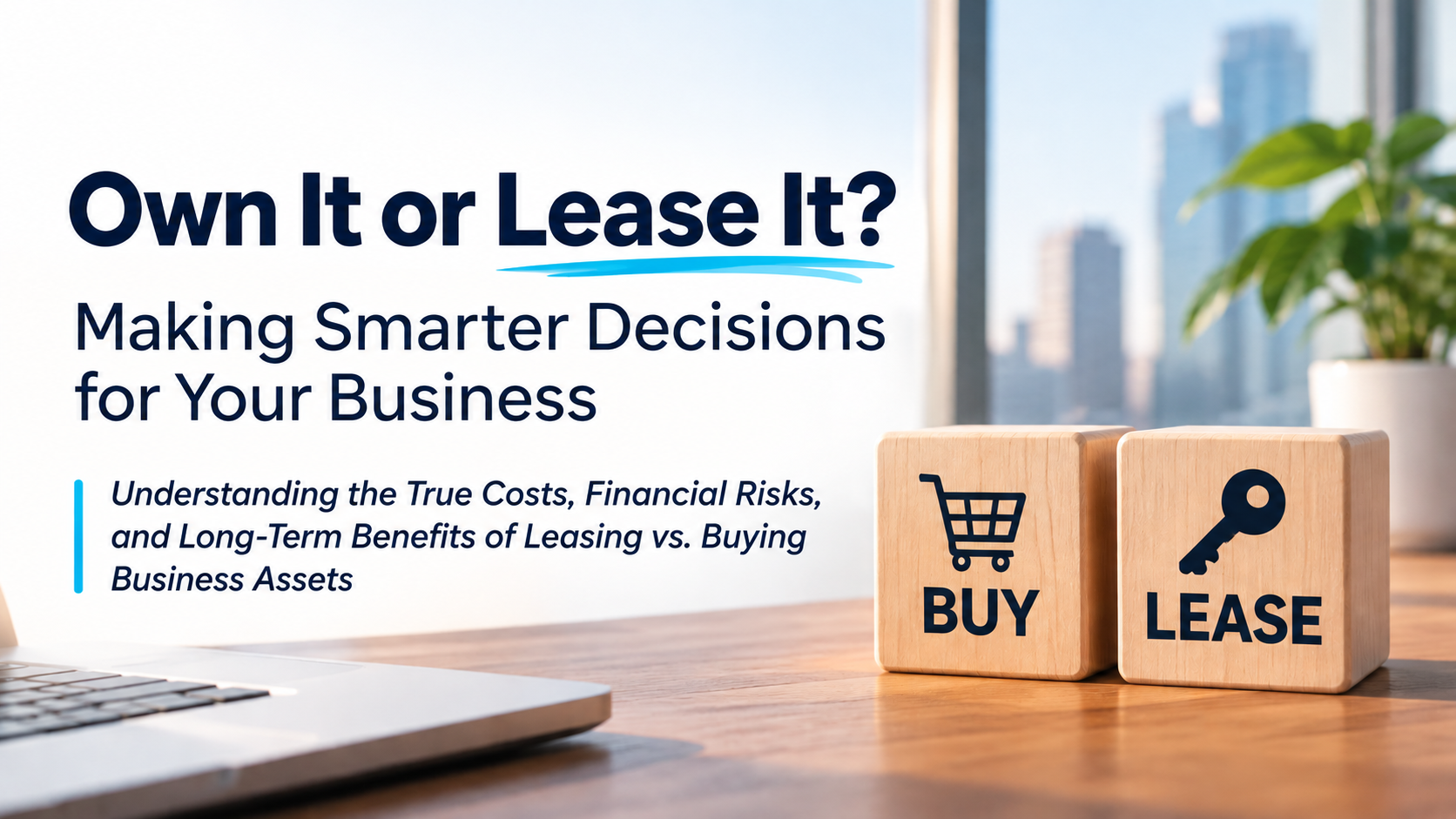
Leasing vs. Buying Business Assets: Understanding Lease Accounting, Financial Obligations, and Business Growth
RR Capital Insights | Accounting & Financial Advisory
Category: Accounting & Financial Reporting | Business Financial Management
Estimated reading time: 12–15 minutes
Introduction: Leasing Is More Than a Monthly Payment
Every business eventually faces an important financial decision: Should it purchase the assets necessary to operate, or would leasing be a better alternative?
Whether a company needs office space, commercial vehicles, manufacturing equipment, technology infrastructure, or specialized machinery, the decision between leasing and purchasing can significantly affect its cash flow, financial position, profitability, and long-term growth.
For many small and growing businesses, leasing offers an attractive alternative to ownership. Instead of committing substantial capital upfront, a company can obtain access to the assets it needs through contractual payments over an agreed period.
However, leasing is not simply a matter of paying monthly rent.
Lease agreements create financial commitments that business owners must understand, evaluate, and manage. Depending on the structure of the agreement, leasing can influence a company's reported assets, liabilities, operating expenses, financial ratios, and borrowing capacity.
Under the Financial Accounting Standards Board's Accounting Standards Codification Topic 842 (ASC 842), lease accounting has also become more transparent, requiring businesses that prepare financial statements under U.S. Generally Accepted Accounting Principles (GAAP) to recognize most leases on their balance sheets.
Understanding these requirements is essential not only for accounting compliance but also for making informed financial decisions.
In this article, RR Capital explores how business leases work, the differences between operating and finance leases, their effects on financial statements, and how business owners can evaluate leasing as part of a broader financial management strategy.
1. What Is a Business Lease?
A lease is a contractual arrangement in which one party grants another party the right to use a specified asset for an agreed period in exchange for payments.
A lease generally involves two parties:
Lessee: The business or individual obtaining the right to use the asset.
Lessor: The business or individual that owns the asset and provides the right to use it.
For example, suppose a transportation company needs five commercial trucks to expand its delivery operations. Rather than purchasing all five vehicles, the company enters into an agreement with a leasing provider.
The transportation company becomes the lessee, while the leasing provider is the lessor.
The transportation company receives the right to use the trucks during the lease term and agrees to make payments according to the contract.
Although the transportation company may not legally own the trucks, it receives economic benefits from using them and assumes certain financial obligations.
This distinction between legal ownership and economic substance is fundamental to modern lease accounting.
Common Assets Businesses Lease
Businesses frequently lease:
- Commercial buildings and office space
- Warehouses and distribution facilities
- Commercial vehicles and transportation equipment
- Manufacturing machinery
- Computers, servers, and technology infrastructure
- Medical and specialized professional equipment
- Retail stores and restaurant facilities
- Construction and agricultural equipment
Leasing arrangements are common across industries because businesses often need access to productive assets without necessarily wanting to own them.
2. Why Do Businesses Choose Leasing Instead of Purchasing?
Leasing can provide several financial and operational advantages.
A. Preserving Working Capital
One of the primary advantages of leasing is reducing the amount of cash required upfront.
Consider a business that needs equipment valued at $150,000.
Purchasing the equipment outright would require a substantial immediate cash investment. Leasing may allow the company to obtain the same equipment with a smaller initial payment followed by periodic payments.
The company could potentially use its remaining cash for payroll, inventory, marketing, hiring, or other operating needs.
For growing businesses, maintaining sufficient working capital can be just as important as acquiring productive assets.
However, leasing does not necessarily mean the asset will cost less over its total useful life.
B. Improving Cash Flow Flexibility
Lease agreements generally establish scheduled payments, allowing businesses to plan their cash requirements more predictably.
A company paying $2,500 per month for equipment may find it easier to manage cash flow than a company making a large upfront purchase.
Predictable payments can support budgeting, cash flow forecasting, and operational planning.
Nevertheless, lease payments remain contractual obligations. A company must ensure it can meet those obligations even when revenue declines.
C. Reducing Exposure to Obsolescence
Some assets lose economic value quickly because of technological improvements, changing consumer demand, or industry developments.
Computers, specialized machinery, and certain commercial equipment may become outdated before the end of their physical useful lives.
Depending on the agreement, leasing may allow businesses to replace or upgrade equipment more frequently without assuming the full risk associated with ownership.
D. Operational Flexibility
Leasing may offer greater flexibility when businesses expand, relocate, or change their operating models.
For example, a company entering a new geographic market may prefer leasing office space rather than purchasing commercial real estate.
This can reduce the financial commitment associated with entering an uncertain market.
However, flexibility depends on the contract. Some leases contain strict termination provisions, renewal conditions, or penalties.
E. Potential Tax Considerations
Lease arrangements may have tax implications, including the timing and deductibility of payments.
The tax treatment depends on the nature of the agreement, applicable tax laws, and the business's circumstances.
Importantly, the classification of a lease for financial reporting purposes does not automatically determine its treatment for federal income tax purposes.
Businesses should evaluate accounting and tax considerations separately.
3. Understanding ASC 842: The Modern Lease Accounting Standard
Historically, certain operating leases were not recognized as assets and liabilities on a company's balance sheet.
This created an important financial reporting concern.
A business could have substantial long-term payment obligations without those obligations appearing directly among its reported liabilities.
Consequently, investors, lenders, and other financial statement users sometimes needed to examine disclosure notes to understand a company's total leasing commitments.
To improve transparency and comparability, the FASB issued Accounting Standards Update 2016-02, establishing the modern lease accounting framework under ASC 842.
What Changed?
Under ASC 842, lessees generally must recognize two financial statement elements for leases longer than 12 months.
Right-of-Use Asset
A right-of-use asset represents the company's contractual right to use an underlying asset during the lease term.
Lease Liability
A lease liability represents the present value of the company's obligation to make future lease payments.
These amounts generally appear on the company's balance sheet, even when the company does not legally own the underlying asset.
Certain qualifying short-term leases may be excluded from balance sheet recognition if the company elects the applicable accounting policy.
Why Does This Matter?
Consider two businesses operating in the same industry.
Company A purchases its commercial equipment using borrowed funds.
Company B leases similar equipment under a long-term agreement.
Both companies have financial commitments associated with obtaining productive assets.
Modern lease accounting helps financial statement users recognize and evaluate those commitments more consistently.
For business owners, this means lease decisions should be considered alongside other financing and capital investment decisions.
4. Finance Leases vs. Operating Leases
Under U.S. GAAP, businesses acting as lessees generally classify leases as either finance leases or operating leases.
Although both classifications generally require recognition of a right-of-use asset and lease liability, they differ in how expenses are recognized and presented.
Finance Leases: Similar to Financing an Asset Purchase
A finance lease is an arrangement that transfers substantially all the economic benefits and risks associated with ownership of an asset to the lessee.
Economically, the transaction resembles purchasing an asset through financing.
For example, suppose a manufacturing company leases specialized machinery for nearly its entire economic life.
The company makes periodic payments and receives substantially all the economic benefits of using the machinery.
Even if legal ownership remains with the lessor, the economic substance of the agreement may resemble a financed purchase.
Under finance lease accounting, the lessee generally recognizes two separate expense components:
Amortization expense: Represents the cost associated with using the right-of-use asset over time.
Interest expense: Represents the financing cost associated with the outstanding lease liability.
Because interest expense generally decreases as the liability is repaid, total finance lease expenses are often higher during the earlier years of the agreement.
This is commonly referred to as a front-loaded expense pattern.
Operating Leases: Similar to Renting an Asset
An operating lease generally represents an arrangement in which the lessee obtains the right to use an asset without meeting the criteria for finance lease classification.
For example, a business may lease office space for five years while the building has a substantially longer remaining economic life.
The company uses the property during the lease period but does not obtain substantially all the economic benefits associated with ownership.
Under operating lease accounting, the lessee generally recognizes a single lease expense on a straight-line basis over the lease term.
This means the total expense recognized in each period is generally consistent, even though the underlying financial calculations include interest and amortization components.
Key Differences Between Finance and Operating Leases
| Financial Consideration | Finance Lease | Operating Lease |
|---|---|---|
| Economic substance | Similar to a financed asset purchase | Similar to a rental arrangement |
| Right-of-use asset | Recognized | Recognized |
| Lease liability | Recognized | Recognized |
| Expense presentation | Interest and amortization separately | Generally one lease expense |
| Expense pattern | Often higher in earlier years | Generally straight-line |
| Principal cash payments | Financing cash flows | Operating cash flows |
| Interest cash payments | Operating cash flows | Included in operating lease cash payments |
Neither classification is automatically better for a business.
The appropriate classification depends on the contractual terms and applicable accounting requirements.
5. How Do Businesses Determine Lease Classification?
ASC 842 provides five principal criteria for determining whether a lessee should classify an arrangement as a finance lease.
If any one of these criteria is met, the lease generally qualifies as a finance lease.
Criterion 1: Transfer of Ownership
The agreement specifies that ownership of the underlying asset transfers to the lessee by the end of the lease term.
Criterion 2: Purchase Option
The agreement provides a purchase option that the lessee is reasonably certain to exercise.
Criterion 3: Major Portion of Economic Life
The lease term covers the major part of the remaining economic life of the underlying asset.
Criterion 4: Substantially All of Fair Value
The present value of lease payments, together with applicable residual value guarantees, represents substantially all the fair value of the underlying asset.
Criterion 5: Specialized Asset
The asset is so specialized that it is expected to have no alternative use to the lessor at the end of the lease term.
If none of these criteria is satisfied, the arrangement is generally classified as an operating lease.
Business owners should understand that lease classification is determined by the economic substance of the agreement, not simply by what the contract is called.
A document titled "Equipment Rental Agreement" may still qualify as a finance lease depending on its terms.
6. Understanding Lease Liabilities and the Time Value of Money
One of the most important financial concepts in lease accounting is the present value of future payments.
A company may agree to pay $30,000 annually for five years, creating total contractual payments of $150,000.
However, the initial lease liability generally does not equal the simple sum of those future payments.
Instead, the liability is measured using the present value of the applicable lease payments.
Why Present Value Matters
Money available today has a different economic value from money payable several years in the future.
Present value accounts for this difference by discounting future payments using an appropriate interest rate.
Under ASC 842, businesses generally use the interest rate implicit in the lease when that rate is readily determinable.
Otherwise, the lessee generally uses its incremental borrowing rate, subject to applicable accounting policy elections.
The result is a measurement of the company's current obligation associated with its future lease payments.
How Lease Liabilities Change Over Time
As the company makes lease payments, its outstanding liability generally decreases.
Each finance lease payment typically contains two economic components:
- A financing cost, representing interest on the outstanding obligation.
- A principal repayment, reducing the amount owed.
As the outstanding balance decreases, the interest component generally declines.
This pattern resembles the repayment of an installment loan.
For business owners, understanding the difference between total payments, interest costs, and outstanding principal is important when evaluating long-term financial commitments.
7. How Leasing Affects a Company's Financial Statements
Leasing can influence all three major financial statements.
A. Balance Sheet
The balance sheet reports a company's assets, liabilities, and equity.
Under ASC 842, most leases create both a right-of-use asset and a lease liability.
As a result, leasing can increase reported total assets and total liabilities.
This may influence financial ratios such as:
Debt-to-equity ratio: Certain calculations may include lease liabilities as debt, potentially increasing reported financial leverage.
Current ratio: The current portion of lease liabilities may affect the company's short-term liquidity position.
Return on assets: Recognition of additional assets can influence measures of asset efficiency.
Debt service coverage: Lenders may consider contractual lease payments when evaluating the company's ability to meet financial obligations.
The exact effect depends on the financial ratio definition and how the lender or analyst treats lease liabilities.
B. Income Statement
The income statement reports revenue, expenses, and profitability.
For finance leases, interest and amortization expenses are generally presented separately.
For operating leases, a single lease expense is generally recognized.
These differences can affect operating income, interest expense, and performance measures such as EBITDA.
For example, finance lease amortization and interest are commonly excluded from EBITDA calculations, while operating lease expense generally reduces EBITDA.
However, EBITDA definitions vary, particularly in lending agreements and adjusted financial reporting.
Business owners should not assume that a higher EBITDA figure necessarily means stronger cash flow or improved profitability.
C. Statement of Cash Flows
The statement of cash flows explains how cash enters and leaves a business.
Finance lease payments are generally divided into two classifications:
Operating activities: Interest payments.
Financing activities: Principal repayments.
Operating lease payments are generally classified as operating cash flows.
This distinction matters because a company with substantial finance leases may report different operating cash flow figures than a company with economically similar operating leases.
Financial analysts should consider these differences when comparing companies.
8. How Lease Accounting Can Affect Borrowing Capacity
Lease obligations can influence how lenders evaluate a business.
When a company applies for financing, lenders may review its existing liabilities, recurring payment obligations, profitability, cash flow, and debt service capacity.
Long-term lease commitments can be important because they represent future cash requirements.
Consider a business with annual revenue of $1 million and substantial lease payments for vehicles, equipment, and commercial property.
Although the company may report positive accounting income, it must still generate enough cash to meet those contractual obligations.
A lender may evaluate whether the business can comfortably make both its existing lease payments and payments on a proposed new loan.
Important Financial Questions
Before entering into a significant lease, business owners should consider:
- How much additional cash must the business generate to support the payments?
- Will the lease improve revenue or operational efficiency?
- How will the agreement affect the company's existing financial obligations?
- Does the company have sufficient liquidity during slower business periods?
- Will the lease restrict its ability to obtain additional financing?
A lease should support the company's financial strategy rather than create obligations that exceed its operating capacity.
9. Lease Terms, Renewal Options, and Termination Provisions
Lease agreements often contain provisions that can significantly influence their economic value and accounting treatment.
Renewal Options
Some agreements allow a business to extend the lease beyond its original term.
Under ASC 842, renewal periods are generally included in the lease term when the lessee is reasonably certain to exercise the option.
For example, a business may enter into a five-year lease with an option to extend for another five years.
Whether the additional period is included in the accounting lease term depends on the relevant facts and circumstances.
Termination Options
Some agreements permit early termination, potentially subject to penalties.
These provisions may provide flexibility but can also create financial risks.
Business owners should understand the cost of ending a lease before its scheduled expiration.
Variable Lease Payments
Not every lease requires identical payments throughout its term.
Some agreements adjust payments based on inflation, market rates, business activity, or equipment usage.
For example, a commercial lease may increase annual payments based on a consumer price index.
Payments linked to an index or rate are treated differently for initial measurement purposes from many payments based on future sales or usage.
These provisions can introduce uncertainty into future cash flow projections.
Residual Value Guarantees
Certain agreements require the lessee to guarantee a minimum value for the leased asset at the end of the lease term.
If the asset's actual value falls below the guaranteed amount, the lessee may have an additional payment obligation.
This is particularly important for vehicles, specialized machinery, and other assets whose values can change significantly.
10. Lease Accounting from the Asset Owner's Perspective
So far, the discussion has focused primarily on businesses leasing assets from others.
However, businesses that lease property or equipment to customers must also understand the lessor's accounting perspective.
Under U.S. GAAP, lessors generally classify leases into three categories.
Sales-Type Leases
A sales-type lease resembles a sale of an asset combined with financing.
The lessor generally removes the underlying asset from its balance sheet and recognizes a net investment in the lease.
If the transaction generates a selling profit, that profit is generally recognized when the lease commences.
Interest revenue is subsequently recognized over the lease term.
This arrangement is particularly relevant to manufacturers and equipment dealers that provide financing arrangements to customers.
Direct Financing Leases
A direct financing lease is primarily a financing arrangement rather than a traditional rental transaction.
The lessor generally removes the underlying asset and recognizes a net investment in the lease.
The lessor earns interest revenue over the lease term, while any selling profit is deferred and recognized through the financing yield.
This structure is commonly associated with financing-oriented leasing arrangements.
Operating Leases
Under an operating lease, the lessor generally retains the underlying asset on its balance sheet.
The lessor continues depreciating the asset and recognizes lease revenue over the lease term.
For example, a company that owns commercial office buildings and rents them to tenants may account for qualifying arrangements as operating leases.
Understanding the lessor's perspective is especially important for real estate investors, equipment leasing companies, and businesses generating recurring rental income.
11. Leasing vs. Buying: Which Is Better for Your Business?
There is no universal answer.
The right decision depends on the company's financial position, operational needs, industry, growth objectives, and long-term strategy.
Leasing May Be More Attractive When:
- The company wants to preserve upfront cash.
- Equipment becomes technologically outdated quickly.
- Operational flexibility is important.
- The business expects to relocate or change capacity.
- Management prefers predictable contractual payments.
- Ownership is not essential to the company's long-term strategy.
Purchasing May Be More Attractive When:
- The asset will be used for a substantial portion of its useful life.
- The business has sufficient capital or affordable financing.
- Ownership provides long-term strategic advantages.
- The asset retains meaningful resale value.
- Total ownership costs are lower than total leasing costs.
- The company wants greater control over modifications and disposal.
Example: Evaluating a Commercial Vehicle
Assume a growing business needs a commercial vehicle valued at $60,000.
It has two alternatives.
Option A: Purchase the Vehicle
The business purchases the vehicle using cash or financing.
It generally assumes responsibility for maintenance, depreciation, financing costs, and eventual resale.
However, it retains ownership and may benefit from the vehicle's residual value.
Option B: Lease the Vehicle
The business enters into a five-year lease requiring monthly payments.
This may reduce upfront cash requirements, but the company becomes obligated to make payments according to the agreement.
Depending on the contract, the company may face mileage restrictions, maintenance responsibilities, termination penalties, or residual value exposure.
The better choice cannot be determined solely by comparing the monthly payment amounts.
A comprehensive financial analysis should consider total costs, cash flow timing, financing rates, tax implications, operational restrictions, and the asset's expected economic value.
12. Five Common Mistakes Businesses Make When Leasing Assets
Mistake 1: Focusing Only on Monthly Payments
A lower monthly payment does not automatically mean a lower total cost.
Businesses should evaluate the entire agreement, including fees, interest, maintenance obligations, renewal terms, and termination penalties.
Mistake 2: Ignoring Long-Term Financial Commitments
Lease payments may appear manageable individually, but multiple agreements can create substantial combined obligations.
Management should monitor total commitments rather than reviewing each lease in isolation.
Mistake 3: Confusing Lease Expense with Cash Payments
Accounting expenses and cash payments do not always occur in the same amounts or periods.
A business may report lease-related expenses that differ from the cash paid during a reporting period.
Understanding this distinction is essential for accurate financial planning.
Mistake 4: Overlooking Financial Statement Effects
Lease classification and recognition can affect reported liabilities, expenses, cash flows, and financial ratios.
These changes may influence lender evaluations and management performance reporting.
Mistake 5: Failing to Evaluate the Business Purpose
The most important question is not simply whether a company can afford a lease.
It is whether the leased asset will contribute sufficient operational or financial value to justify the commitment.
An asset that does not improve productivity, support revenue, reduce costs, or strengthen operations may become a financial burden.
13. The Role of Financial Planning in Lease Decisions
Leasing should be evaluated as part of a company's overall financial management strategy.
Before committing to a major lease, management should consider several areas.
Cash Flow Forecasting
Estimate future cash inflows and outflows to determine whether the business can consistently meet lease obligations.
Budgeting
Incorporate scheduled payments, expected increases, maintenance costs, and other contractual expenses into operating budgets.
Profitability Analysis
Evaluate whether the asset is expected to generate sufficient economic benefits to justify its cost.
Capital Allocation
Compare leasing with other potential uses of capital, including purchasing assets, reducing debt, investing in technology, or expanding operations.
Financial Risk Management
Evaluate the impact of lower-than-expected revenue, increased operating costs, and unexpected business disruptions.
Long-Term Strategic Planning
Determine whether the lease supports the company's anticipated growth, operating model, and financial objectives.
A well-structured lease can support business expansion. A poorly evaluated agreement can constrain liquidity and limit future opportunities.
14. How RR Capital Helps Businesses Make Better Financial Decisions
At RR Capital, we believe accounting should provide more than a historical record of business transactions.
Financial information should help business owners understand their current position, identify risks, evaluate opportunities, and make informed decisions.
Leasing is one example of how accounting information connects directly to business strategy.
A lease may appear to be a routine operational agreement, but its financial implications can extend across cash flow management, financial reporting, profitability, financing readiness, and long-term capital planning.
RR Capital's accounting and financial advisory approach focuses on helping businesses better understand these connections.
Our relevant service areas include:
Accounting & Financial Reporting
Helping businesses organize financial information, understand assets and liabilities, and improve financial reporting processes.
CFO & Financial Management Advisory
Supporting budgeting, cash flow forecasting, financial performance analysis, and capital allocation decisions.
Business & Transaction Advisory
Helping businesses evaluate significant financial commitments, business investments, financing readiness, and transaction-related risks.
Financial Technology & Intelligence
Using financial analysis, reporting tools, and technology-enabled insights to support more informed business decisions.
Whether a company is considering commercial equipment, office space, vehicles, or other long-term operating assets, understanding the financial implications of its commitments is an important part of responsible business management.
Conclusion: Leasing Is a Financial Strategy, Not Just an Operating Expense
Leasing can be a valuable financial tool for businesses seeking flexibility, operational efficiency, and access to productive assets without substantial upfront investment.
However, every lease represents a financial decision with potential long-term consequences.
Modern lease accounting under ASC 842 has made these obligations more visible by requiring most leases to be recognized on the balance sheet.
For business owners, the objective should extend beyond complying with accounting requirements.
The more important goal is understanding how leasing decisions affect cash flow, profitability, financial risk, borrowing capacity, and sustainable growth.
Before signing a significant lease agreement, businesses should evaluate the complete financial commitment, compare available alternatives, and determine whether the arrangement supports their broader business objectives.
A successful financial decision is not simply about obtaining an asset. It is about obtaining the right asset, under the right terms, at the right cost, for the right business purpose.
About RR Capital
RR Capital, LLC is a technology-enabled accounting and strategic financial advisory firm focused on helping privately owned and growing businesses better understand their financial performance, manage cash flow, improve profitability, and make confident growth decisions.
Beyond Accounting. Toward Financial Growth.
Website: https://rrcapitalllc.com
Educational Disclaimer
This article is provided for general educational and informational purposes only. It is not intended to constitute individualized accounting, tax, legal, investment, or financial advice. Lease accounting and tax treatment depend on specific contractual terms, applicable reporting standards, and individual circumstances. Businesses should consult qualified professionals before making significant financial or accounting decisions.
References
- Financial Accounting Standards Board (FASB), Accounting Standards Codification Topic 842, Leases.
- FASB Accounting Standards Update No. 2016-02, Leases (Topic 842).