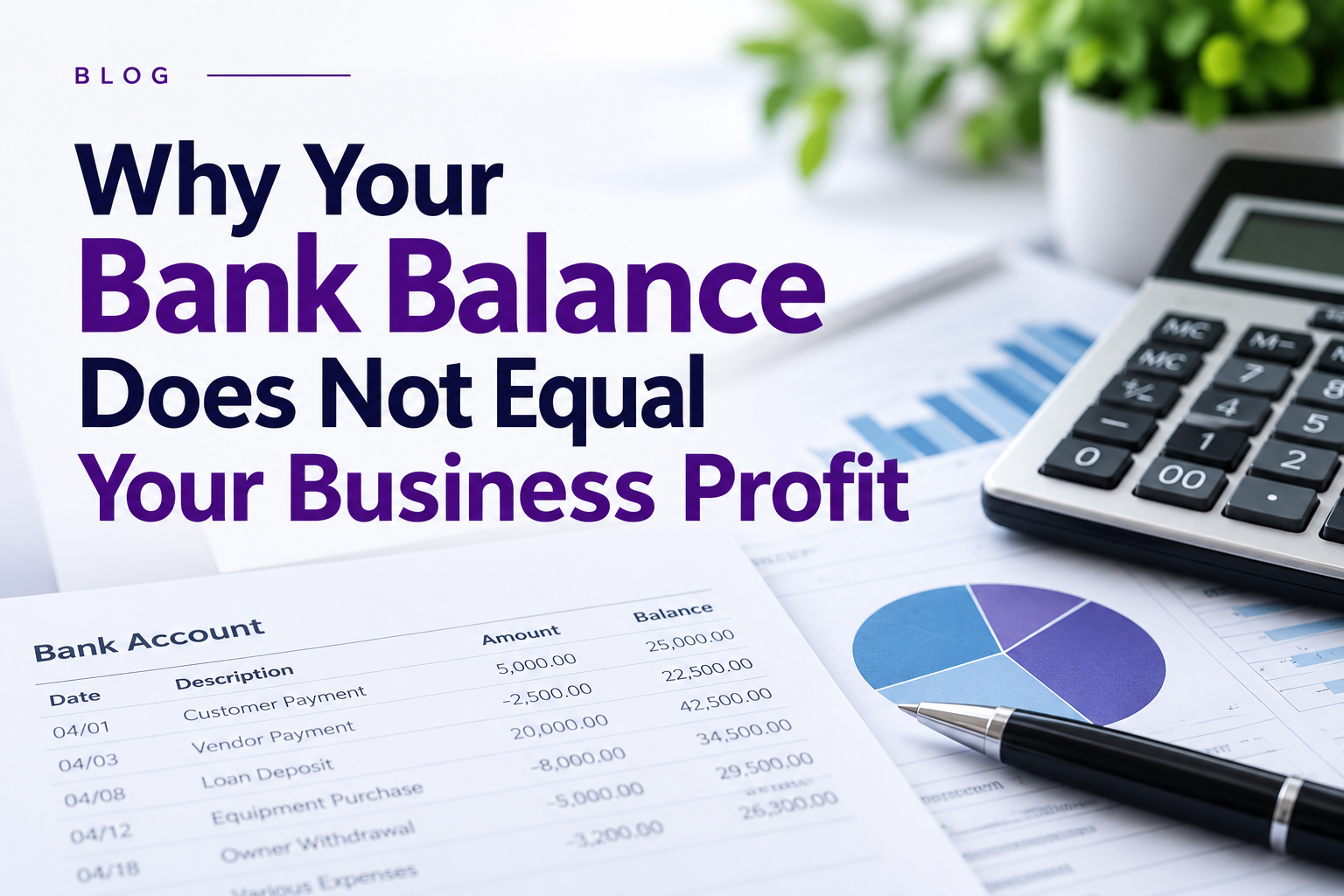
Why Your Bank Balance Does Not Equal Your Business Profit
A business owner opens the company’s bank account and sees $75,000 available.
Does that mean the business has made $75,000 in profit?
Not necessarily.
One of the most common financial misunderstandings among business owners is assuming that the amount of money in the business bank account represents the company’s profit.
Your bank balance tells you how much cash is currently available in a particular account.
Your profit tells you whether the business generated more revenue than expenses during a particular period.
These are two different measurements.
Understanding the difference between cash and profit is essential for evaluating the financial health of a business and making informed decisions.
What Is Business Profit?
At its simplest level, profit is calculated by comparing revenue with expenses.
Revenue − Expenses = Profit
Suppose a business generates:
Revenue: $200,000
Expenses: $150,000
Net Profit: $50,000
The company generated $50,000 of accounting profit during the period.
However, this does not necessarily mean the company's bank account increased by $50,000.
Why?
Because many business transactions affect cash without immediately affecting profit, while other transactions can affect profit without immediately affecting cash.
That distinction is fundamental to understanding business finances.
What Does Your Bank Balance Tell You?
Your bank balance generally tells you how much cash is currently available in your bank account.
It reflects cash that has entered and left the account.
Cash may enter a business through activities such as:
- Customer payments
- Owner contributions
- Business loans
- Collection of accounts receivable
- Sale of business assets
Cash may leave the business through:
- Operating expenses
- Loan payments
- Equipment purchases
- Owner withdrawals or distributions
- Inventory purchases
- Tax payments
- Payments to vendors
Not every cash deposit represents revenue, and not every cash payment represents an expense.
This is why looking only at the bank account can create a misleading picture of profitability.
Example: Cash in the Bank Does Not Necessarily Mean Profit
Suppose a business begins the month with $20,000 in its bank account.
During the month, the owner contributes another $30,000 to the business.
The bank account now contains $50,000, assuming no other transactions.
Did the business earn $30,000 of profit?
No.
The $30,000 owner contribution increased the company's cash, but it is generally an equity transaction—not business revenue.
Now suppose the company also receives a $50,000 business loan.
The bank balance could increase to $100,000.
Again, the company has not generated $80,000 of profit.
The loan increased cash, but it also created a liability that the business is obligated to repay.
A large bank balance can therefore exist even when the business has generated little or no profit.
The Opposite Can Also Happen
A profitable business can sometimes have relatively little cash available.
Suppose a consulting company earns $100,000 in revenue during the month and incurs $60,000 in expenses.
Its accounting profit may be:
$100,000 − $60,000 = $40,000
But suppose customers have only paid $50,000 of the $100,000 they owe.
The remaining $50,000 is still in accounts receivable.
The company may report a profit while still waiting to collect a significant amount of cash.
This is particularly important for businesses using accrual accounting.
Profitability does not automatically create immediate liquidity.
Accounts Receivable Can Create Profit Before Cash Arrives
Under accrual accounting, revenue may be recognized when it is earned rather than when the customer actually pays.
Suppose your business completes $25,000 of services in December and gives the customer 30 days to pay.
The business may recognize:
Revenue: $25,000
Accounts Receivable: $25,000
The revenue contributes to the company's profit.
But the company's bank account has not yet received the $25,000.
This creates an important distinction:
The business earned the money, but it has not collected the money.
A company can therefore look profitable on its income statement while experiencing cash-flow pressure.
Accounts Payable Can Make Cash Look Better Temporarily
The opposite situation can occur with unpaid bills.
Suppose a company receives $15,000 of services from vendors but has 30 days to pay the invoices.
Under accrual accounting, the business may recognize the applicable expenses even though the cash remains in the bank.
The company's bank balance may therefore look relatively strong today.
But part of that cash will eventually be needed to satisfy existing obligations.
This is why business owners should not look at the bank balance without also considering accounts payable and other liabilities.
Loan Payments Create Another Difference
Loan payments are another common source of confusion.
Suppose your business makes a $5,000 loan payment.
The entire $5,000 reduces cash.
But the entire payment is not necessarily an expense on the income statement.
A typical loan payment can include:
Principal — reduces the outstanding loan liability.
Interest — generally represents an expense, subject to applicable accounting and tax rules.
If the payment includes $4,000 of principal and $1,000 of interest, the bank account decreases by $5,000.
However, the accounting treatment of the two portions is different.
The principal payment generally reduces a balance-sheet liability rather than being recorded as an operating expense.
This is another reason:
Cash leaving the bank does not always equal an expense.
Buying Equipment Can Reduce Cash Without Immediately Reducing Profit by the Same Amount
Suppose a business purchases equipment for $30,000 in cash.
The bank account immediately decreases by $30,000.
But depending on the applicable accounting treatment, the entire $30,000 may not immediately appear as an expense on the income statement.
Instead, the equipment may initially be recorded as an asset on the balance sheet, with its cost recognized over time through depreciation for financial reporting purposes.
Tax treatment may differ depending on applicable depreciation rules and elections.
The important concept for a business owner is simple:
Buying an asset can significantly reduce cash even though the same amount does not necessarily reduce accounting profit immediately.
Owner Withdrawals and Distributions
Money taken out of a business by an owner can also create confusion.
Suppose the business generates $80,000 of profit, but the owner withdraws or receives distributions totaling $50,000.
The company's cash decreases.
However, an owner's withdrawal or distribution generally is not an operating expense used to calculate business profit.
Therefore, the business could still report $80,000 of profit even though a significant portion of the cash has been removed from the company.
The exact accounting and tax treatment depends on the entity structure and nature of the transaction.
Owner Contributions Work the Other Way
Suppose the owner contributes $40,000 of personal funds to the company.
Cash increases by $40,000.
But the contribution generally does not represent revenue from business operations.
The company has more cash, but it did not become $40,000 more profitable simply because the owner invested additional money.
This distinction is particularly important when evaluating whether a business is actually supporting itself through operations.
Inventory Can Consume Cash Before Affecting Profit
Inventory creates another important difference between cash and profit.
Suppose a retailer purchases $50,000 of inventory.
The business may have spent $50,000 of cash, but inventory generally remains an asset until the applicable goods are sold.
When inventory is sold, its associated cost becomes part of cost of goods sold under the applicable accounting method.
Therefore, a business can invest significant cash into inventory without immediately recognizing the entire amount as an expense.
A growing business may therefore be profitable while constantly needing additional cash to purchase inventory.
Taxes Can Affect Cash Differently From Book Profit
Tax payments can also cause differences between cash balances and financial-statement profit.
A business may make estimated tax payments, payroll tax deposits, sales tax remittances, or other tax-related payments.
Some amounts collected by a business may also represent money held for another party rather than revenue belonging to the business.
For example, sales tax collected from customers generally creates an obligation to remit the amount to the appropriate taxing authority rather than becoming ordinary business revenue.
This is why having cash in the bank does not necessarily mean all of that cash is economically available to the business owner.
Cash Method Businesses Still Need to Understand the Difference
The distinction between cash and profit is especially visible under accrual accounting, but cash-method businesses should understand it as well.
Even when income and expenses are recognized more closely to cash receipts and payments, transactions such as:
- Loans
- Owner contributions
- Owner withdrawals
- Loan principal payments
- Asset purchases
- Certain inventory transactions
can still cause the bank balance and business profit to differ.
Therefore:
Cash Method does not mean bank balance equals profit.
A Simple Example
Consider a business that begins the year with $25,000 in cash.
During the year:
Revenue collected: $200,000
Operating expenses paid: $140,000
Owner contribution: $20,000
Business loan received: $40,000
Equipment purchased for cash: $25,000
Loan principal repaid: $10,000
Owner withdrawals/distributions: $30,000
Looking only at the bank account would mix all of these transactions together.
But accounting separates them based on what they actually represent.
Revenue and expenses help measure profitability.
Loans create liabilities.
Owner contributions and withdrawals affect equity.
Equipment purchases can create assets.
Loan principal payments reduce liabilities.
This classification allows financial statements to tell a much more meaningful story than the bank balance alone.
Profit, Cash Flow, and Financial Position Answer Different Questions
Business owners should understand three related but different concepts.
Profitability
The Income Statement, also called the Profit and Loss Statement, helps answer:
Did the business generate a profit or loss during the period?
It reports revenue and expenses over a specific period.
Cash Flow
The Statement of Cash Flows helps answer:
Where did the company's cash come from, and where did it go?
Cash flows are generally classified into operating, investing, and financing activities.
This helps explain why cash increased or decreased even when the business reported a profit.
Financial Position
The Balance Sheet helps answer:
What does the business own, what does it owe, and what is the owners' equity at a specific point in time?
It reports assets, liabilities, and equity.
Together, these financial statements provide a much more complete picture of a business than a bank balance alone.
Why Profitable Businesses Can Still Run Out of Cash
A business can report strong sales and accounting profits and still experience financial difficulty.
This can happen when:
Customers take too long to pay.
Too much cash is tied up in inventory.
The company purchases significant equipment or other assets.
Debt payments consume substantial cash.
Owners withdraw too much money.
The company grows faster than its working capital can support.
Expenses must be paid before customer payments are collected.
This is sometimes called a cash-flow problem rather than a profitability problem.
However, persistent cash-flow problems can eventually become serious operational problems even for an otherwise profitable business.
Employees, vendors, lenders, and tax authorities generally need to be paid with cash—not accounting profit.
Why a High Bank Balance Can Also Be Misleading
A high bank balance does not automatically mean a business is financially healthy.
Imagine a company has $150,000 in cash.
But it also has:
Accounts Payable: $60,000
Loan Obligations: $35,000
Payroll and Payroll Taxes Due: $20,000
Other Current Liabilities: $15,000
A large portion of the company's cash may already be needed to meet existing obligations.
Looking only at the $150,000 bank balance could create a false sense of financial strength.
What Should Business Owners Review?
Instead of asking only:
“How much money is in my bank account?”
Business owners should also ask:
Is my business profitable?
How much do customers owe me?
How much do I owe vendors?
What debt obligations are coming due?
How much cash is being generated by normal operations?
How much money am I withdrawing from the business?
How much cash is tied up in inventory or other assets?
Can the business comfortably meet its upcoming obligations?
These questions provide a much stronger foundation for financial decision-making.
Your Bank Account Is Important—but It Is Only One Piece
Monitoring cash is extremely important.
Businesses need cash to pay employees, vendors, taxes, lenders, and operating expenses.
But a bank account was not designed to measure business profitability.
That is the role of accounting and financial reporting.
A properly maintained accounting system helps connect:
Bank Accounts
Revenue
Expenses
Assets
Liabilities
Equity
Profit
and Cash Flow
Understanding how these pieces work together allows business owners to move beyond simply watching the bank balance and begin managing the financial performance of the business.
The Bottom Line
Your bank balance and your business profit answer two different questions.
Bank Balance: How much cash is currently in the account?
Profit: How much revenue did the business generate relative to its expenses during a particular period?
The two numbers can be very different.
Loans, owner contributions, distributions, accounts receivable, accounts payable, equipment purchases, inventory, debt payments, and other transactions can all create differences between cash and profit.
That is why successful financial management requires more than checking the bank account.
Business owners should understand their Income Statement, Balance Sheet, and Cash Flow Statement together.
Your bank balance tells you how much cash you have today. Your accounting records help explain how your business is actually performing.
This content is intended for general educational and informational purposes only and should not be considered individualized accounting, tax, legal, or financial advice. Accounting and tax treatment can vary depending on the facts, accounting method, entity structure, and applicable laws and regulations. Business owners should consult qualified professionals regarding their specific circumstances.